
The one figure no strategy touches
96.00% stays fixed regardless of difficulty, stake size or cash-out timing.
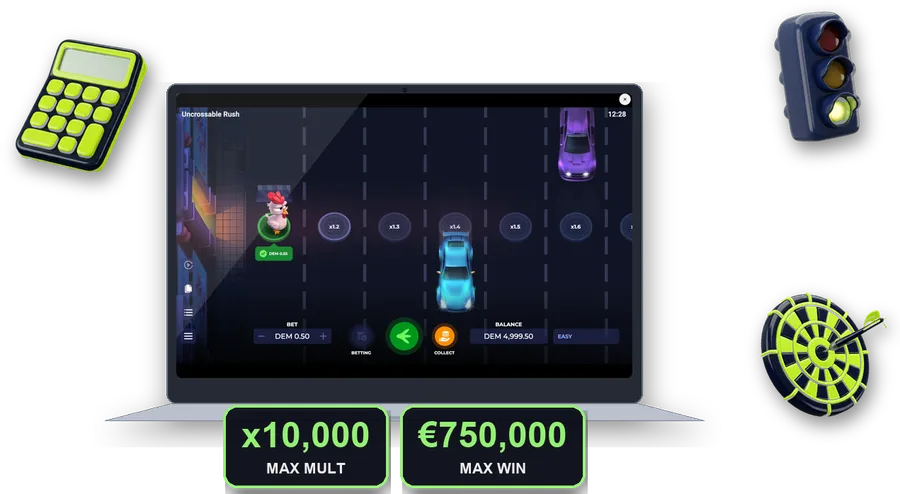
No betting pattern and no difficulty choice changes the 96.00% RTP Evoplay publishes for Uncrossable Rush. That figure describes the game as a whole, and nothing decided before or during a round is stated to adjust it.
What a player actually controls is exposure and timing: the difficulty setting chosen before the round starts, the stake size measured against a bankroll, and the point at which a player cashes out relative to how much traffic is still ahead. Those are decisions about risk, not about the return built into the game.
Every technique covered on this page operates on those three levers and nothing else. A technique presented as a way to move the published 96.00% itself is not describing this game accurately, and none of what follows claims to do that.
Difficulty changes the ceiling, not the average
Higher settings raise what a good round can pay and what a bad one costs. The long-run figure stays where it is.
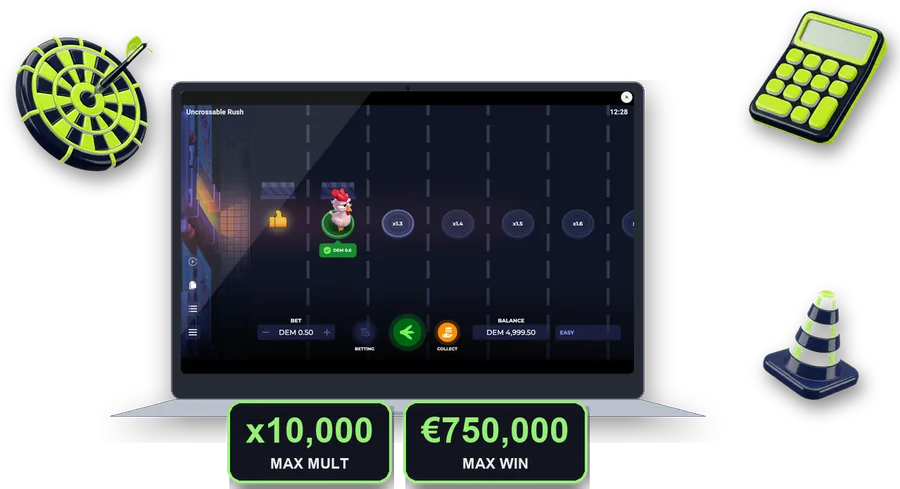
Choosing Easy through Hardcore is the single decision in Uncrossable Rush that changes what a stake is actually exposed to. Evoplay states that raising the setting increases both the speed of the traffic and the number of cars on the road, which raises the chance of a collision on any given lane; it is not simply a bigger-prize toggle sitting on top of an unchanged game.
Because the setting is fixed before the round starts and cannot be adjusted lane by lane once traffic is moving, this decision happens once per round. Picking Hardcore commits to denser, faster traffic across every lane of that round, not only at the very end where the payout is largest, in exchange for the higher ceiling Evoplay ties to that setting, up to the game's published x10,000 maximum multiplier.
The practical result is variance, not a change in the published return. A run of rounds played entirely on Hardcore will tend to produce more short, stake-clearing rounds than the same number of rounds played on Easy, even though the 96.00% figure Evoplay states does not move between the two settings.
The table below sets out what Evoplay confirms changes at each setting and what it confirms stays fixed, without inventing a payout ladder the provider has not published for any of the four.
| Setting | Traffic, per Evoplay's own description | Payout on a round that goes well | RTP |
|---|---|---|---|
| Easy | Slower, fewer cars, lowest collision risk of the four | Lowest of the four settings | 96.00%, same published figure |
| Medium | Faster and denser than Easy | Higher than Easy | 96.00%, same published figure |
| Hard | Faster and denser than Medium | Higher than Medium | 96.00%, same published figure |
| Hardcore | Fastest and densest, highest collision risk of the four | Highest of the four, tied to the published x10,000 ceiling | 96.00%, same published figure |
Evoplay states the direction of each relationship, faster settings raise both risk and payout, without publishing exact figures between the four levels. This table reports the confirmed direction, not invented numbers.
Sizing a stake against a bankroll, not against a hoped-for win
The one number a player fixes directly, with no published ceiling to plan around.
The stake set before a round begins is the only number a player fixes directly, and Evoplay does not publish a minimum or maximum figure for it. Sizing that stake against a bankroll set aside for the session, rather than against how much a cash-out might eventually be worth, is what keeps a run of early collisions from ending a session in a handful of rounds.
Difficulty changes what that sizing needs to account for. Because Hardcore raises the chance of an early collision on any given lane, a stake that feels reasonable on Easy carries more risk of being lost quickly on Hardcore, even though neither setting changes the underlying 96.00% figure. Bankroll sizing has to account for the difficulty chosen, not the stake amount alone.
Autoplay adds a further constraint worth planning around before starting a run rather than mid-sequence. Evoplay's autoplay for Uncrossable Rush fixes the bet size and the difficulty level for the entire sequence, so a bankroll decision made once at the start applies to every round inside that run; there is no adjusting the stake partway through the way a manual player could between individual rounds.
Because no maximum stake is published, this page cannot state a ceiling a bankroll should be measured against the way it can for games where the provider sets one. What is confirmed instead is the structure: a fixed stake per round, raised by each safe crossing, cleared entirely by a single collision, with the difficulty setting deciding how often that collision happens.
Martingale, and why the failure point cannot be calculated here
Doubling after a loss fails on any stake-based game eventually. Where exactly is not something this page can state for this one.
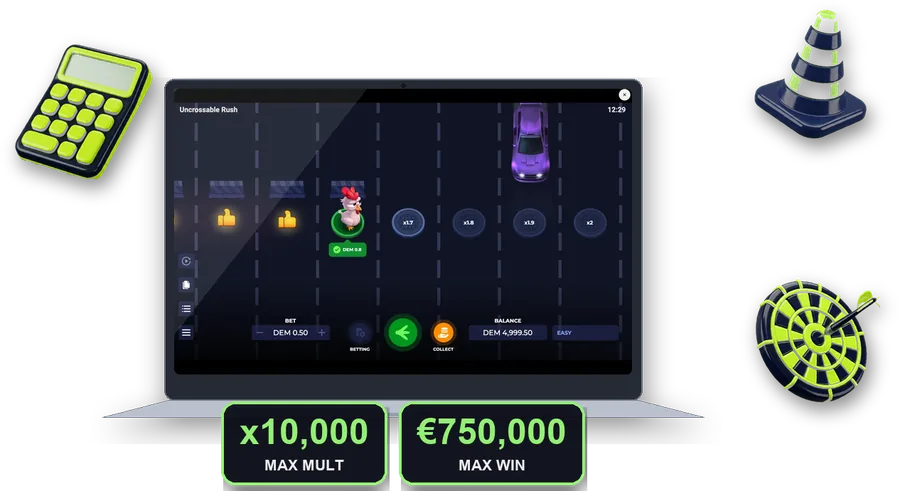
A martingale progression, doubling the stake after every loss so a single win recovers everything lost before it, does not perform any better on Uncrossable Rush than on any comparable stake-based game. It does not change the 96.00% RTP, and it fails once a losing run makes the required stake unaffordable or unavailable.
Evoplay does not publish a maximum stake for Uncrossable Rush, so this page cannot state the exact bet at which a martingale progression would hit a hard ceiling here the way it can for a game with a published limit. The mechanism that breaks the system does not depend on knowing that number: a doubling progression grows exponentially, and a real losing run, which a game averaging 96.00% will produce sooner or later, exhausts either the bankroll behind it or whatever unpublished limit exists, well before the recovery math resolves.
It is worth naming plainly as a false system regardless of the missing ceiling: martingale cannot turn a 96.00% RTP game into a winning one. It changes the shape of a losing run, rare and large instead of frequent and small, without changing the average, and presenting it as a way to beat Uncrossable Rush misrepresents what the technique actually does.
Evoplay does not publish a maximum stake for Uncrossable Rush, so this page cannot calculate the exact point at which a martingale progression hits the game's own limit.
The two exits Evoplay builds directly into autoplay
Stop on Profit and Stop on Loss turn a manual decision into one the game enforces automatically.
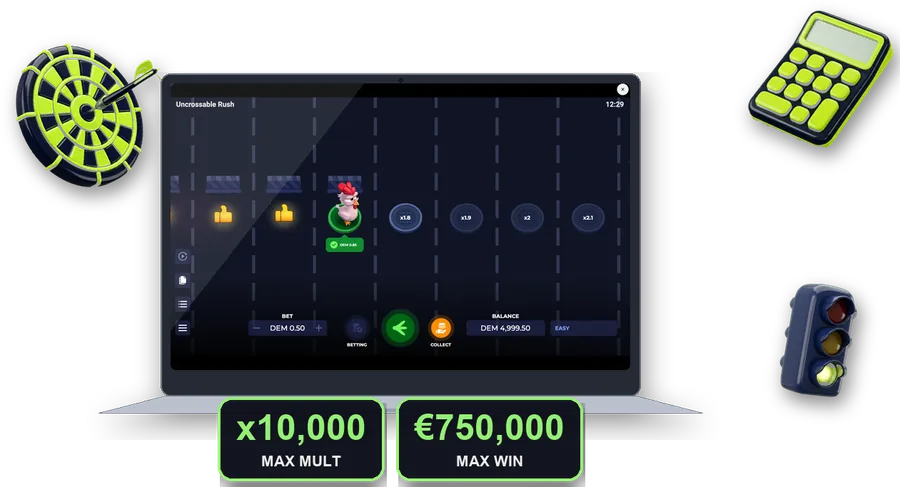
Evoplay builds two automatic exits into the autoplay settings for Uncrossable Rush: Stop on Loss and Stop on Profit. Setting either one before a run starts turns an exit that would otherwise depend on noticing and deciding in the moment into one the game enforces on its own, once the preset threshold is reached.
Stop on Loss caps how much of a bankroll a single autoplay run can lose before the sequence ends automatically. That matters specifically at the higher difficulty settings, where Evoplay states the traffic itself carries a higher chance of an early collision on any given lane, since that is where an unmanaged run loses ground fastest.
Cash Out On Win, and the separate behaviour set for On Win and On Loss, decide what happens automatically after each round inside the sequence rather than when the whole run ends, and the fixed number of bets and bet size set the shape of the run in advance. None of those settings change the 96.00% RTP either; they only decide how reliably a chosen exit point actually gets used instead of being talked past mid-session.
Two claims that circulate which Evoplay does not support
A volatility rating and a prediction system both circulate for this game. Neither traces back to the provider.
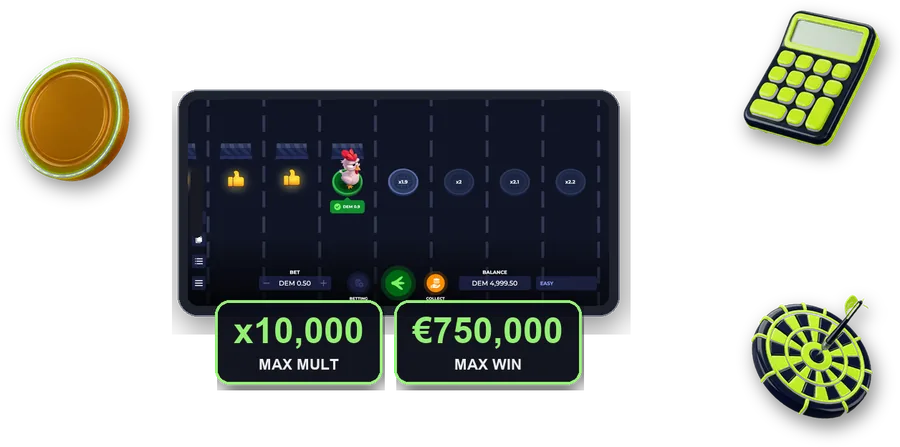
Some pages describing Uncrossable Rush rate its volatility High, stated as flatly as a confirmed specification. Evoplay's own page does not publish a volatility rating for this game at all, so a rating like that is a guess dressed up as a fact, and this page reports volatility as not published rather than adopting either a High rating or any other one.
That gap matters for how Hardcore in particular gets talked about. Treating an unconfirmed High volatility rating as the reason to chase Hardcore for supposedly bigger swings adds a claim to the game that Evoplay has not made; what is confirmed is the relationship between difficulty and traffic covered earlier on this page, not a volatility classification.
A belief that a collision now makes a safe crossing more likely on the next lane, sometimes called the gambler's fallacy, is false on Uncrossable Rush the same way it is false everywhere else: each lane resolves independently, and nothing about a losing run changes what the next lane's traffic does.
Claims that a particular time of day, a particular operator's build, or a pattern in recent rounds predicts the next lane are not addressed anywhere in Evoplay's published material for this game, and this page does not adopt them. Where a claim cannot be traced to something the provider actually states, it is a belief about the game, not a fact about it.
Straight answers
Uncrossable Rush · Evoplay
Does any betting system change Uncrossable Rush's RTP?
No. Only Evoplay's own build changes the 96.00% figure; staking patterns and difficulty choices only change how that figure is experienced across a session.
Is difficulty a genuine strategic decision?
Yes, the biggest one available. It changes the traffic itself, faster and denser at higher settings, and the payout ceiling on a round that goes well, without moving the published RTP.
Why can't this page say exactly where martingale fails on this game?
Evoplay does not publish a maximum stake for Uncrossable Rush, so the exact bet at which a doubling progression would hit a hard ceiling is not something this page can calculate. The progression still fails eventually, for the same structural reason it fails on any stake-based game.
What do Stop on Loss and Stop on Profit actually do?
They are autoplay settings that end a run automatically once a preset loss or profit is reached, without requiring a player to notice and act in the moment.
Is Uncrossable Rush's volatility rated High?
Evoplay does not publish a volatility rating for this game at all. Ratings circulating elsewhere are not confirmed by the provider, and this page does not adopt one.
Does choosing Easy instead of Hardcore cost anything extra?
No. Difficulty is a setting choice, not a separate paid tier; it changes the traffic and the payout ceiling, not what it costs to select.